
Fixing a cracked seal costs about forty dollars. A full windows replacement project runs north of twenty grand. Somewhere between those two numbers sits the decision you’re trying to make before your house hits the market, and the gap is where sellers lose money.
I’ve bought houses with beautiful new casement units and houses where the glass rattled in the frame every time a truck went by. That contrast taught me buyers care about windows, yes, but not in the way most listing advice suggests. The arithmetic on a pre-sale windows replacement job rarely lands where homeowners want it to.
What Do Buyers Think About Old Windows?
Then a buyer walks into a 1962 ranch with gleaming vinyl, opens the hall closet, and finds a water stain. Suddenly the windows aren’t the story anymore.
Buyers rarely price windows as a line item. They price a feeling. Old single-pane glass with peeling paint tells them the whole property has been deferred, and that suspicion spreads to the roof, the furnace, the panel box. One seller I worked with had sunk real money into a partial windows replacement on the street-facing side only. The back of the house still had original wood sash. Every buyer who walked the yard noticed, and the half-finished look did more damage than leaving all of them alone would have.
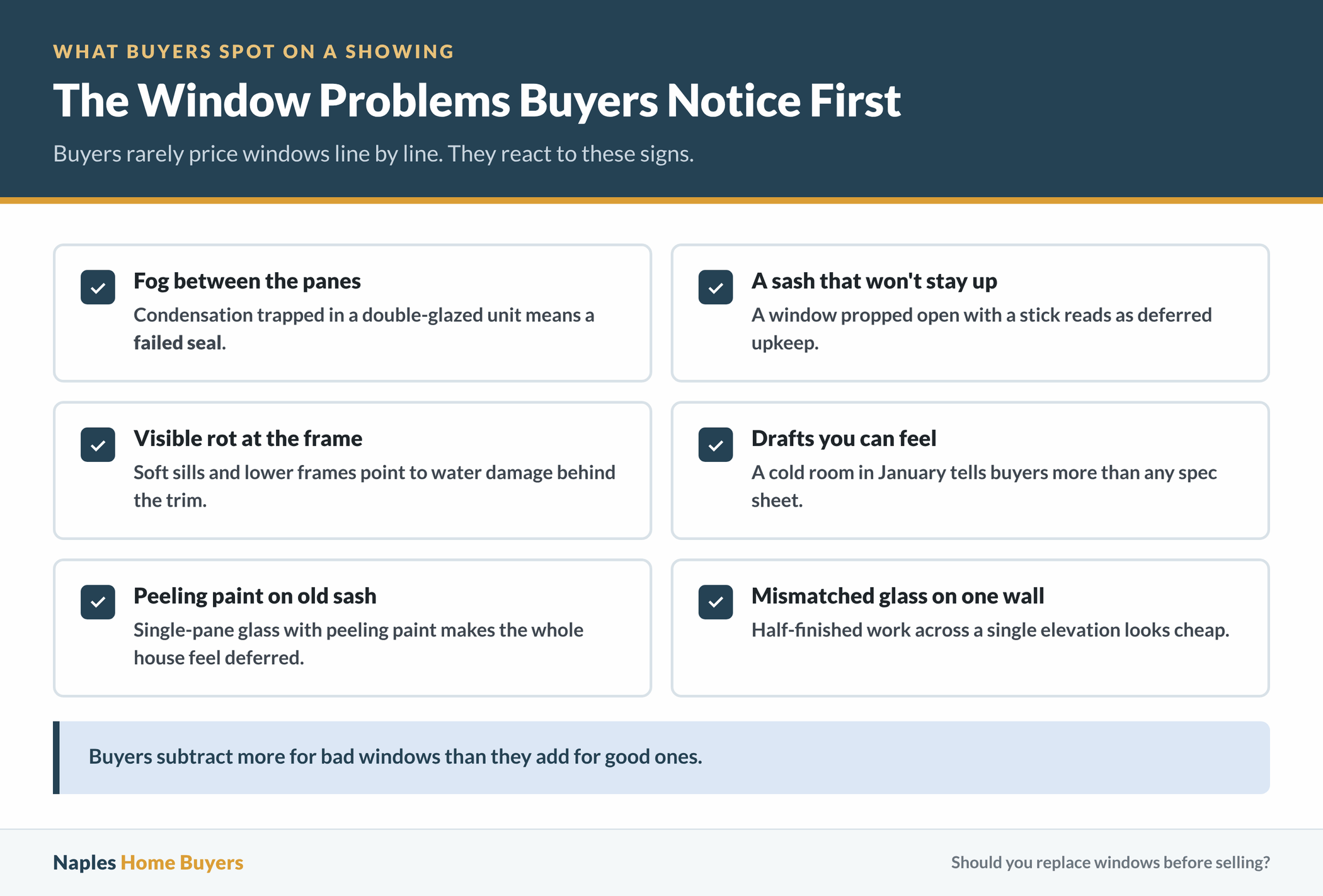
A buyer standing in your living room does notice: condensation trapped between panes, a sash that won’t stay up without a stick, visible rot at the frame, drafts you can feel in January. Those are the tells. Fog in the glass is the loudest one, because it signals a failed seal on a double-glazed unit and buyers know the windows replacement isn’t free.
Buyers won’t know a window’s efficiency rating. They know whether the room feels cold.
What I keep seeing is that buyers subtract more for bad windows than they add for good ones. Tired glazing gets a house marked down hard in negotiation. A house with a fresh windows replacement gets a nod and a “nice, we won’t have to handle that,” which is appreciation, not a premium. The asymmetry matters when you’re deciding where to spend.
Should You Repair or Replace Old Windows First?
Repair almost always wins when the frame is sound.
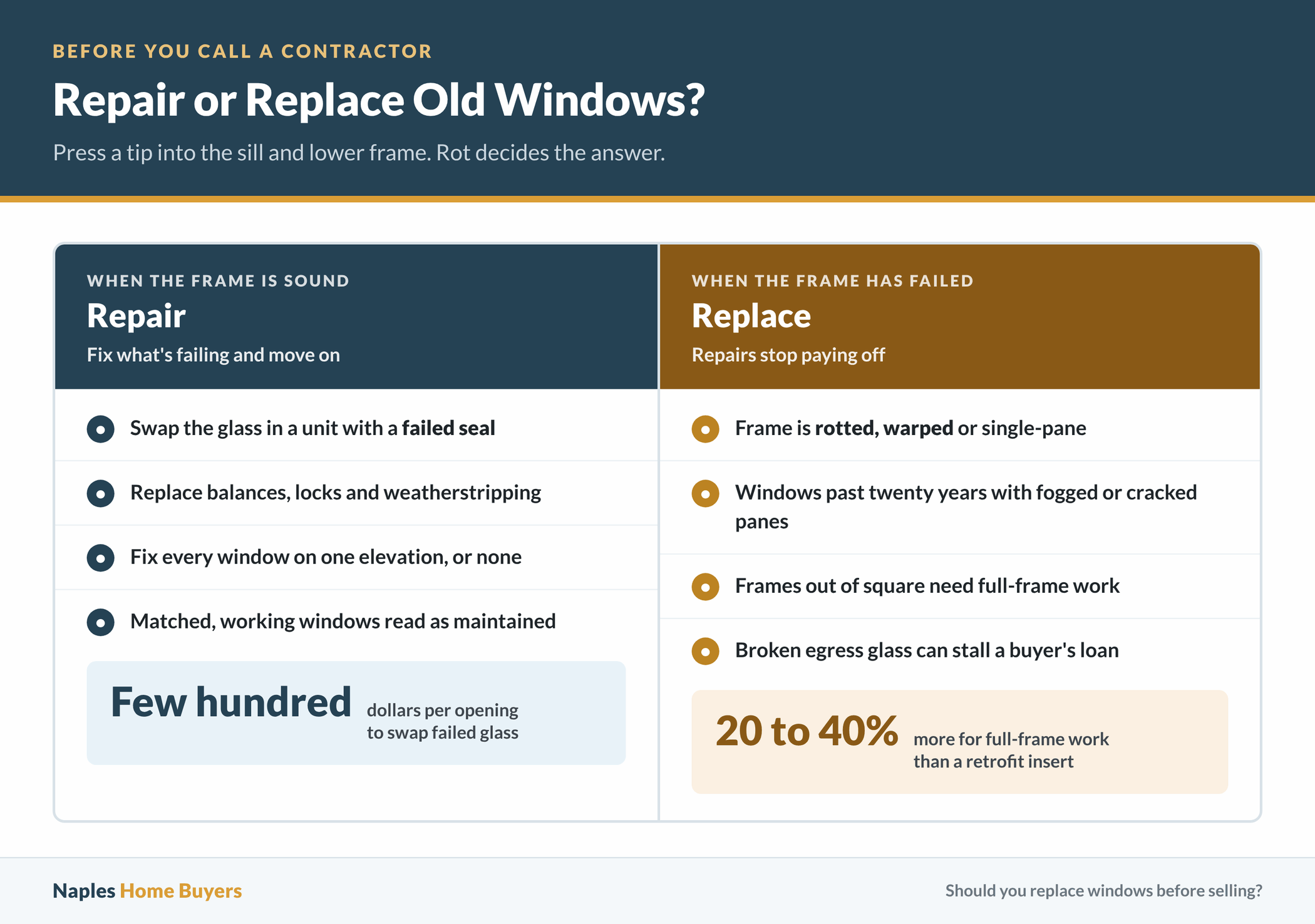
A failed seal on an insulated glass unit can often be addressed by swapping the glass itself. This job typically runs a few hundred dollars per opening rather than the full per-window cost of a replacement. Hardware fixes cost even less. Balances, locks, weatherstripping: those are afternoon fixes that make a window operate like a window again.
Rot changes the equation. When the frame is rotted, warped, or single-pane, windows replacement delivers better long-term value. Windows past twenty years old with fogged or cracked panes almost always cost less to replace than to keep repairing. Press the tip into the sill and the lower frame of each unit. If it sinks in, you’ve got rot. When it bounces off, you’ve got a repair candidate.
A while back I handled a sale for a widow outside Westfield, Massachusetts. She’d gotten a job transfer and had five weeks to be out of the house. Her contractor had quoted a full windows replacement for the whole second story, and she was ready to sign on a Thursday morning before we talked it through. The garage was still full of her husband’s woodworking tools and nothing had been sorted yet.
She closed on time.
Partial windows replacement gets a bad reputation, but it’s defensible if you’re consistent about it. So fix every window on one elevation or none. Mismatched glass across a single wall reads as cheap. Matched, functional windows across the whole house read as maintained, even when they’re forty years old.
What Happens During a Windows Replacement Project?
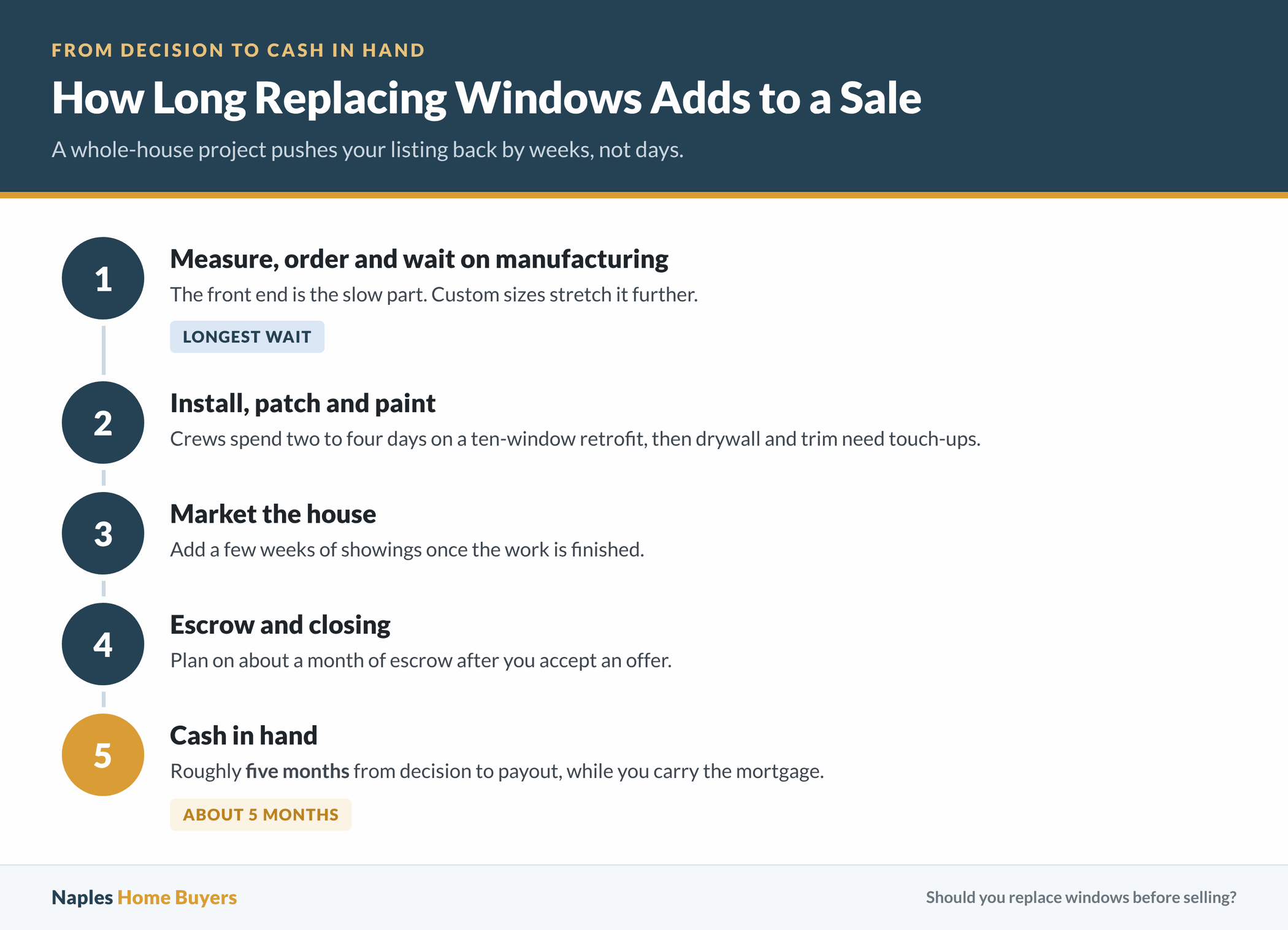
Owners worry the install will eat their listing schedule, and they’re mostly wrong on the timeline. A standard retrofit on a ten-window house usually takes crews two to four days of actual labor. The long part is really the front end: measuring, ordering, waiting on manufacturing. Custom sizes stretch that further.
There are two installation approaches, and the difference is money. An insert, or pocket, installation drops the new unit into your existing frame, so the exterior stays untouched. A full-frame windows replacement strips everything down to the rough opening, including the trim and sill.
Full-frame work costs 20 to 40 percent more than retrofit insert work, and it’s required when frames are rotted or out of square. That’s from the cost analysis at Hammerio’s 2026 window replacement cost guide, and it tracks with what I’ve paid on rehabs.
During installation you’ll have open holes in your walls for an hour or so at a time. Crews work one or two openings at a time for exactly that reason.
Interior trim is where sellers get surprised. Pull a window and the drywall around it often needs patching and repainting, which nobody quotes until the invoice. Budget for paint touch-up on every room that gets new glass.
Permits vary by state and municipality. Your local building department is the only office that can tell you whether a like-for-like windows replacement triggers one in your jurisdiction. Some require inspection for egress compliance in bedrooms. Skipping that step creates a disclosure headache later.
One more thing worth checking: some manufacturers require a trained professional to install windows for the long-term warranty to hold, per ENERGY STAR’s homeowner guidance. Void that warranty and it’s worthless paper.
How Much Does a Windows Replacement Project Cost?
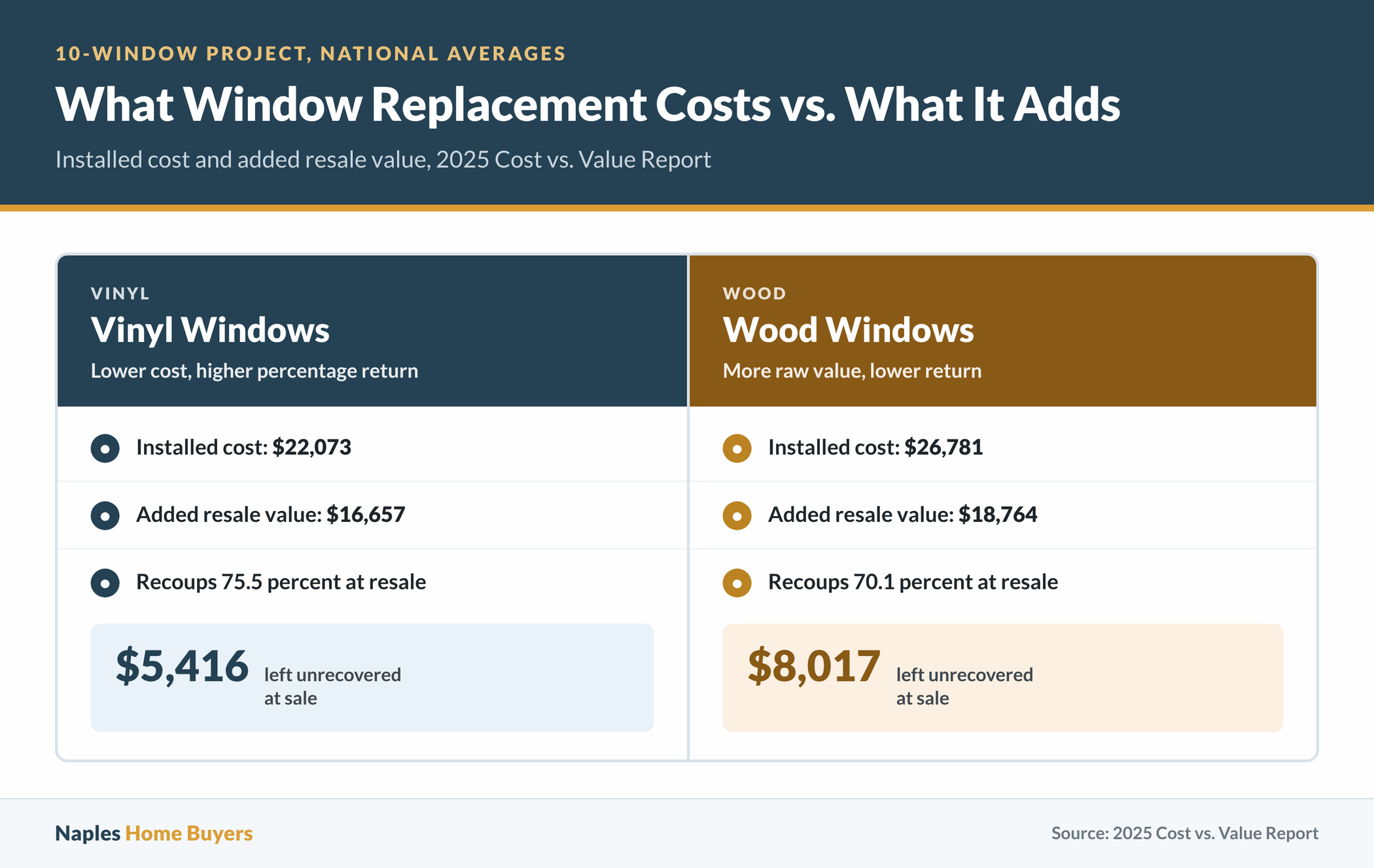
Nationally, a ten-window vinyl replacement project averaged $22,073 in the 2025 Cost vs. Value Report, while the same project in wood averaged $26,781, and those are installed figures, not material costs. Per-window, the average replacement window runs about $477 installed.
Your house probably doesn’t have ten windows. Most three-bedroom homes I buy have somewhere between twelve and twenty openings once you count the basement and the bathroom units nobody thinks about. Count every opening when you price the windows replacement.
Material drives the spread. Vinyl sits at the bottom, fiberglass and composite in the middle, wood and clad-wood at the top. Triple glazing adds cost over standard double glazing and makes sense in hard winter climates; in a mild coastal market it’s money you won’t see again. Custom shapes, specialty hardware on sash windows, and anything requiring historic-district approval push the number up fast.
Would I spend twenty thousand dollars on a house I’m selling in sixty days? No. I wouldn’t, and I tell sellers the same thing when they ask me across their kitchen table.
Financing deserves a mention since most homeowners don’t have that sitting in checking. The 2026 Houzz & Home Study found 84 percent of renovating homeowners tapped savings. Plenty of others borrow. A home equity line against a house you’re about to sell gets paid off at closing anyway. In effect, you’re borrowing to fund a project whose return you’ll learn about in escrow.
You’re spending certain money for uncertain recovery, on a timeline you don’t fully control.
Are There Grants or Rebates for Windows Replacement?
A seller called me in September holding three contractor quotes and a printout about federal tax credits he’d found online. He’d budgeted assuming he’d get thirty percent back.
The Section 25C energy efficient home improvement credit is gone. It terminated for property placed in service after December 31, 2025, according to the IRS guidance on the 2025 tax law. Windows installed now don’t qualify federally, even though a lot of contractor marketing still references that credit. Verify anything a salesperson tells you about tax benefits against the IRS site directly.
State and utility programs are a different story and they’re still alive in many places. Plenty of utilities offer rebates for better-performing replacement windows, and the program requirements differ from one to the next. Your electric or gas provider’s efficiency department is the place to ask. Some state housing finance agencies also run weatherization assistance for income-qualified households, though those programs generally target owner-occupants who plan to stay, not sellers.
Low-income weatherization is administered through state agencies with federal funding, and eligibility rules differ state to state. If you think you might qualify, your state energy office can tell you where applications go.
Here’s my practical read: rebate hunting is worth about one phone call before you commit to a windows replacement, and no more than that. Programs that reimburse a few hundred dollars don’t change a twenty-thousand-dollar decision. They’re nice if you’re doing the work anyway for your own comfort over the next decade.
Selling in the next few months? Then the rebate question is mostly moot, because the application and inspection cycles on most programs outlast your listing window.
How Much Value Do New Windows Add to a Home?
Appraisers adjust for overall condition, and a windows replacement moves a house from “fair” toward “average” or “good” in that assessment, which is where the dollars actually come from.
That distinction explains why ROI studies on windows replacement land lower than many owners hope. The 2025 report puts added resale value at $16,657 for a vinyl project and $18,764 for a wood project. So wood adds about $2,107 more in resale value but costs $4,708 more to install. You can read the full breakdown at GetWindowCost’s ROI analysis.
Energy performance is the other half of the value story, and it’s real even though it’s slow. Certified windows from the ENERGY STAR program lower household energy bills by an average of up to 13 percent nationwide when they replace single-pane units, per the EPA’s residential windows page. That’s a meaningful number for someone staying ten years. It’s close to irrelevant for someone moving in spring.
Climate zone shifts the math too. ENERGY STAR’s modeling shows annual savings of $568 in the Northern Zone when replacing single-pane glass, against $282 when the old windows were clear double-pane. Roughly half the benefit disappears if your existing windows are already insulated glass, even failed insulated glass.
Buyers in colder markets do assign real weight to double-glazed windows and good glazing specs. In mild climates, buyers mostly just want the window to open and close without a fight. Know which market you’re in before you spend.
A seller in a seven-figure neighborhood with original 1920s sash windows faces a different calculation entirely, since period-appropriate restoration often preserves more value than vinyl ever would.
Does Windows Replacement Help a House Sell Faster?
Two nearly identical colonials listed the same month on the same street. One had fresh windows and sold in under three weeks; the other sat ten weeks, took two price cuts, and closed below the first house.
The second house also had a dated kitchen and a cracked driveway, though. Isolating windows replacement as the cause would be sloppy thinking. Sloppy thinking is how sellers end up spending twenty thousand dollars to chase a result they can’t attribute.
What I can say with confidence is that new windows remove objections. They don’t create demand. In a market where buyers have options, removing objections matters more than it does in a frenzy.
Homes took a median 33 days to sell in September 2026, up from 31 days in August, according to the National Association of Realtors’ September 2026 report. Supply held at 4.8 months, with 1.60 million homes on the market. NAR’s chief economist noted that longer days on market hand buyers more negotiating power, so sellers should stay realistic about local conditions.
Inventory is doing the thing it hasn’t done in years: climbing. In October 2026, 20.5 percent of active listings took a price cut during the month, according to Realtor.com data reported by Mortgage Professional America. So one in five sellers is cutting price right now. A windows replacement completed before listing may keep you out of that group. It may also just mean you discount from a higher starting point after spending twenty grand.
Order, manufacture, install, patch, paint: six to ten weeks is a realistic span for a whole-house windows replacement. Add a few weeks of marketing and a month of escrow. You’re looking at five months from decision to cash in hand, during which you’re carrying a mortgage on a house you’ve already left.
What’s the Real Roi on Windows Replacement?
The recovery data isn’t terrible, but it isn’t a profit either. Vinyl window replacement recoups 75.5 percent of its cost at resale and wood recoups 70.1 percent, per the 2025 Remodeling Cost vs. Value Report. Regional results run higher in some places; the same report placed vinyl at an 85.3 percent return in the Pacific region. In Atlanta the figure came in at 70.8 percent, which PR Newswire reported still beats a midrange major kitchen remodel by a wide margin.
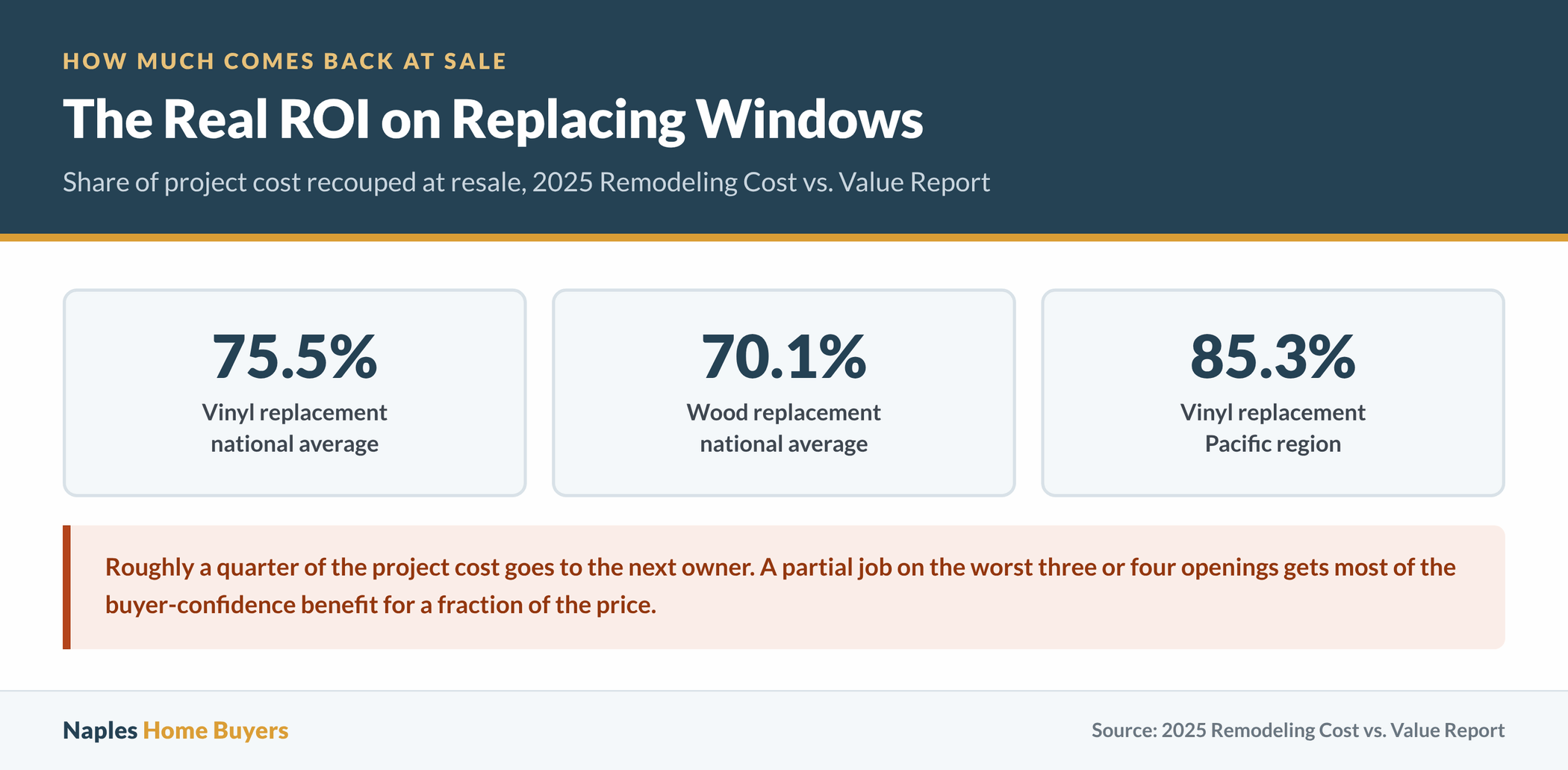
You’re handing roughly a quarter of your project cost to the next owner. On a typical ten-window vinyl job, that’s more than five thousand dollars you’ll never see again. You won’t even be around to enjoy the quieter rooms or the end of winter drafts.
Now compare that to the alternative: disclose the window condition, price the house to reflect it, and let the buyer choose their own glass. Many buyers prefer that. They want casement units where you’d have picked double-hung, or they want the historic sash restored rather than replaced. One exception matters. If failing windows will fail an inspection, kill financing, or make the house unsellable to anyone using a conventional mortgage, that’s not a value question anymore; that’s a windows replacement question. Broken glass in a bedroom egress window or rot that’s reached the sheathing can stop a sale cold. Lending standards don’t bend for a pretty listing photo.
Short of that, a partial windows replacement targeting only the worst three or four openings usually gets you most of the buyer-confidence benefit for a fraction of the price.
Partial work probably won’t move your sale price much. Will you sleep better knowing the inspection report won’t hand a buyer a renegotiation lever? Probably.
Should You Replace Windows Before Selling Your House?
What changed my mind was watching the same pattern repeat. Sellers who did the full windows replacement got a slightly higher sale price and a much lower net. They’d fronted the cost, carried the house longer, and then negotiated against buyers who’d found something else to pick at anyway. Sellers who disclosed honestly and priced accordingly closed faster with more in their pocket.
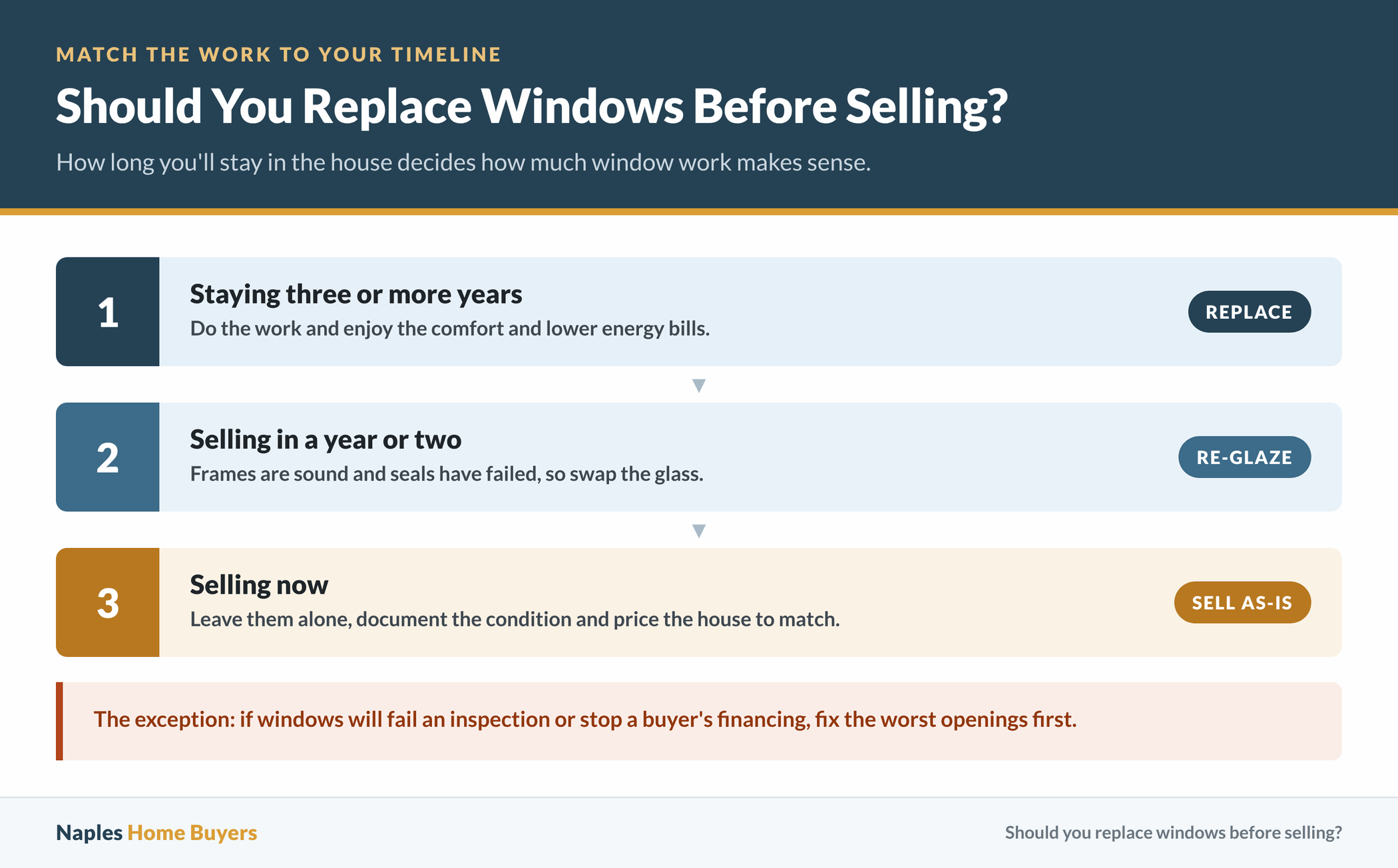
So my current answer breaks into three cases. Staying three or more years? Do the work and enjoy the efficiency and the comfort. Selling in a year or two with sound frames and failed seals? Re-glaze and move on. Selling now? Leave them alone, document the condition, and let the price tell the truth.
Cash sales made up 27 percent of transactions in September 2026, and cash buyers price condition into the offer rather than demanding repairs. If your windows are rough and your timeline is tight, that’s the lane worth exploring. We’ve bought plenty of houses where the glazing was shot and the seller still walked away satisfied. Speed and certainty were worth more to them than a theoretical appraisal bump. If you want an honest read on what your property is worth as-is, the team at Naples Home Buyers will walk through the numbers with you without pushing you toward a sale.
An heir in Holyoke, Massachusetts reached me after inheriting his mother’s bungalow three months behind on the mortgage with an auction date already on the calendar. Every window in the place was original wood, painted shut, with a dead hornets’ nest in the dormer. He’d gotten a windows replacement quote that morning and wanted to know if it would help him refinance.
We closed before the sale date and he kept the equity his mother had built instead of losing it at auction.
Frequently Asked Questions
How Much Does Replacing Windows Increase Home Value?
Less than the project costs, in nearly every case. Industry data consistently shows you recovering most of what you spend, though never all of it. Vinyl outperforms wood on percentage return, even though wood adds slightly more raw dollars. Appraisers fold windows into an overall condition rating rather than crediting them separately. So a windows replacement pays off most in houses where the old glass was dragging the whole condition grade down.
How Often Do Windows Need to Be Replaced?
Most quality units last somewhere between twenty and thirty years, though that range swings hard based on material, climate, and installation quality. Vinyl in a harsh sun belt market degrades faster than the same product in a temperate one. Rather than tracking age, watch for the symptoms: moisture between the panes, frames you can dent with a thumbnail, sashes that won’t hold position, and drafts you can feel with your hand. Those tell you more than the install date ever will.
What Is the Cheapest Time of Year to Replace Windows?
Late fall and winter, generally. Installers in most of the country see demand drop once the weather turns. Slow January calendars make companies more willing to negotiate on price or throw in upgrades. Crews can install in cold weather without trouble since they only open one wall section at a time. The tradeoff is manufacturing lead times, which sometimes stretch after the holidays, so get your measurements done early if you’re working against a listing date.
Will Buyers Ask for a Credit If I Don’t Replace the Windows?
Some will, and you should expect it. A home inspector flagging fogged glass or rotted sills gives a buyer a written reason to come back and ask for money. You’ll usually negotiate that credit down well below what a windows replacement would have cost you. So leaving the work undone and pricing honestly tends to net out better than doing it in advance.
Does a Windows Replacement Project Affect My Property Taxes?
It can, depending on your state and whether the work requires a permit. Permitted improvements sometimes trigger a reassessment, and rules on what counts as assessable differ quite a bit from one state to the next. Your county assessor’s office is the right place to ask before you pull a permit, especially if you’re in a state with assessment caps that reset on improvements.
Can I Sell a House with Old Single-pane Windows?
Absolutely, and people do it every day. Single-pane glass is common in older housing stock across the country, and buyers of those homes generally expect it. Disclose what you know, price the house for its condition, and you’ll find a buyer. Where it gets complicated is when the frames have failed structurally, because that can affect an appraisal or a lender’s willingness to fund.
If you’re weighing a windows replacement against just selling the place as it stands, we’re glad to talk it through with you. No pitch, no obligation, and if the answer is that you should list it with an agent instead, we’ll tell you that too.
How Old Windows Play in Our Local Market
Here in Springfield, the typical home value reached $305,068 by the end of August 2026, up 4.3 percent over the year, according to Zillow. That steady climb gives Springfield sellers real equity to work with, whether they pay for a windows replacement first or sell the house as it stands.
The same thinking holds for homeowners in nearby Chicopee. Older housing stock means plenty of original sash and tired glass, and buyers here price that condition into every offer.
Talk With Us Before You Pay for a Windows Replacement
A window quote costs you nothing, and neither does a conversation with us. If you’d like to see what your house is worth as it stands today, old glass and all, reach out to Naples Home Buyers or use the form below. We’ll walk through the numbers with you, and there’s no obligation to sell.
Helpful Massachusetts Blog Articles
- Can a Jointly Owned Property Be Sold by One Owner in Massachusetts
- How To Get Your House Appraised For Free In Massachusetts
- How to Sell a House on Facebook Marketplace
- How to Find a Realtor in Another State Before You Relocate
- How to Sell Rental Property Without Paying Capital Gains Tax
- What Does Contingent Mean When Buying or Selling a House
- How Soon After Chapter 7 Bankruptcy Can I Sell My House
- Should I Remodel My Kitchen Before Selling
- Selling a House with Water in the Crawl Space in Massachusetts
- Do I Need a Lawyer to Add a Name to a Deed
- Should I Sell My House and Move to an Apartment
- Does Window Replacement Boost Your Home Sale Value?